
图神经网络:(归因方法)解释深度学习模型
Axiomatic Attribution for Deep Networks。归因方法。梯度积分。化学领域。
文章说明:
1)参考资料:PYG的文档。文档超链。
2)博主水平不高,如有错误,还望批评指正。
3)我在百度网盘上传这篇文章jupyter notebook以及有关文献。提取码8848。
文章目录
Mutagenicity数据集
Mutagenicity数据集是用于图分类的数据集。判断该化合物是否具有致突变性。具体信息见代码吧。
导库
from torch_geometric.datasets import TUDataset
下载数据打印信息
dataset=TUDataset(root="C:/Users/19216/Desktop/Project/Project1/Integrated_Gradients",name='Mutagenicity').shuffle()
print(dataset.num_edge_features,dataset.num_node_features,dataset.num_classes,len(dataset))
#输出如下:
#3 14 2 4337
PS:下载有问题就直接手动下载
观察一些图的性质
data=dataset[0];print(data.is_directed());data=dataset[1];print(data.is_directed())
#输出如下:
#False
#False
我们把图给画出来
导库
from torch_geometric.utils import to_networkx
定义格式转换函数
def to_molecule(data):
    ATOM_MAP=['C','O','Cl','H','N','F','Br','S','P','I','Na','K','Li','Ca']
    g=to_networkx(data,node_attrs=['x'])
    for u,data in g.nodes(data=True):
        data['name']=ATOM_MAP[data['x'].index(1.0)]
        del data['x']
    return g
PS:我来描述一下g.nodes(data=True)长啥样吧,不然这段代码虽然很好理解但是过于黑箱: [ ( 元素 1 , { “ x ” : 列表 1 } ) , ( 元素 2 , { “ x ” : 列表 2 } ) , … … ( 元素 n , { “ x ” : 列表 n } ) ] [(元素1,\{“x”:列表1\}),(元素2,\{“x”:列表2\}),\dots\dots(元素n,\{“x”:列表n\})] [(元素1,{“x”:列表1}),(元素2,{“x”:列表2}),……(元素n,{“x”:列表n})]。元素 n n n对应 u u u,这里没用;描述一下列表 n n n: [ i = 1 i f n [ i ] = = A T O M _ M A P [ i ] e l s e 0 f o r i i n r a n g e ( 14 ) ] [i=1 \;if \;n[i]==ATOM\_MAP[i] \;else\;0\; for\;i\;in\;range(14)] [i=1ifn[i]==ATOM_MAP[i]else0foriinrange(14)]。
导库
import matplotlib.pyplot as plt
import networkx as nx
定义分子绘图函数
def draw_molecule(g,edge_mask=None,draw_edge_labels=False):
    g=g.copy().to_undirected()
    node_labels={}
    for u,data in g.nodes(data=True):
        node_labels[u]=data['name']
    pos=nx.planar_layout(g)
    pos=nx.spring_layout(g,pos=pos)
    if edge_mask is None:
        edge_color='black'
        widths=None
    else:
        edge_color=[edge_mask[(u,v)] for u,v in g.edges()]
        widths=[x*10 for x in edge_color]
    nx.draw(g,pos=pos,labels=node_labels,width=widths,edge_color=edge_color,edge_cmap=plt.cm.Blues,node_color='azure')
    if draw_edge_labels and edge_mask is not None:
        edge_labels={k:('%.2f' % v) for k,v in edge_mask.items()}
        nx.draw_networkx_edge_labels(g,pos,edge_labels=edge_labels,font_color='red')
    plt.show()
第一幅图
g1=to_molecule(dataset[0])
draw_molecule(g1)
jupyter notebook内的输出如下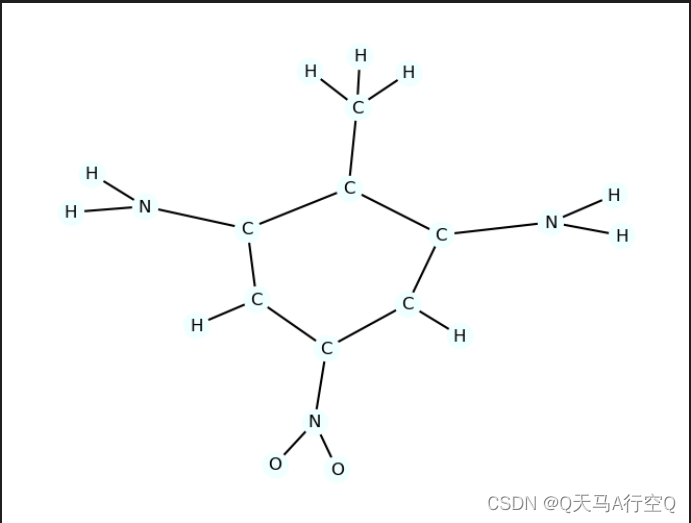
第二幅图
g2=to_molecule(dataset[1])
draw_molecule(g2)
jupyter notebook内的输出如下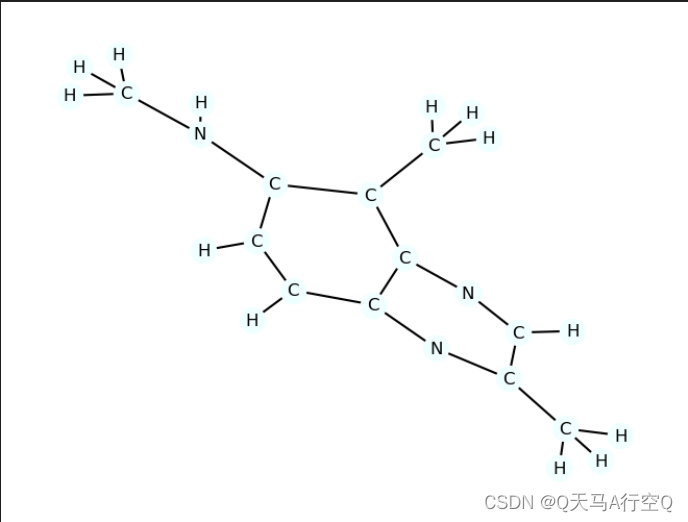
搭建模型
目标是图的二分类。
导库
from torch_geometric.nn import GraphConv,global_add_pool
import torch.nn.functional as F
from torch.nn import Linear
import torch
搭建模型
class Net(torch.nn.Module):

    def __init__(self,dim):
        super(Net,self).__init__()
        self.conv1=GraphConv(dataset.num_features,dim)
        self.conv2=GraphConv(dim,dim)
        self.conv3=GraphConv(dim,dim)
        self.conv4=GraphConv(dim,dim)
        self.conv5=GraphConv(dim,dim)
        self.lin1=Linear(dim,dim)
        self.lin2=Linear(dim,dataset.num_classes)

    def forward(self,x,edge_index,batch,edge_weight=None):
        x=self.conv1(x,edge_index,edge_weight).relu()
        x=self.conv2(x,edge_index,edge_weight).relu()
        x=self.conv3(x,edge_index,edge_weight).relu()
        x=self.conv4(x,edge_index,edge_weight).relu()
        x=self.conv5(x,edge_index,edge_weight).relu()
        x=global_add_pool(x,batch)
        x=self.lin1(x).relu()
        x=F.dropout(x,p=0.5,training=self.training)
        x=self.lin2(x)
        return F.log_softmax(x,dim=-1)
训练模型
训练准备1
model=Net(dim=32)
optimizer=torch.optim.Adam(model.parameters(),lr=0.001)
print(model)
#输出如下:
#Net(
#  (conv1): GraphConv(14, 32)
#  (conv2): GraphConv(32, 32)
#  (conv3): GraphConv(32, 32)
#  (conv4): GraphConv(32, 32)
#  (conv5): GraphConv(32, 32)
#  (lin1): Linear(in_features=32, out_features=32, bias=True)
#  (lin2): Linear(in_features=32, out_features=2, bias=True)
#)
训练准备2
from torch_geometric.loader import DataLoader
test_dataset=dataset[:len(dataset)//10]
train_dataset=dataset[len(dataset)//10:]
test_loader=DataLoader(test_dataset,batch_size=128)
train_loader=DataLoader(train_dataset,batch_size=128)
训练准备3
def train(epoch):
    model.train()
    if epoch==51:
        for param_group in optimizer.param_groups:
            param_group['lr']=0.5*param_group['lr']
    loss_all=0
    for data in train_loader:
        data=data.to(device)
        optimizer.zero_grad()
        output=model(data.x,data.edge_index,data.batch)
        loss=F.nll_loss(output,data.y)
        loss.backward()
        loss_all+=loss.item()*data.num_graphs
        optimizer.step()
    return loss_all/len(train_dataset)

def test(loader):
    model.eval()
    correct=0
    for data in loader:
        data=data.to(device)
        output=model(data.x,data.edge_index,data.batch)
        pred=output.max(dim=1)[1]
        correct+=pred.eq(data.y).sum().item()
    return correct/len(loader.dataset)
开始训练
for epoch in range(1,101):
    loss=train(epoch)
    train_acc=test(train_loader)
    test_acc=test(test_loader)
    print(f'Epoch: {epoch:03d}, Loss: {loss:.4f}, 'f'Train Acc: {train_acc:.4f}, Test Acc: {test_acc:.4f}')
jupyter notebook内的输出如下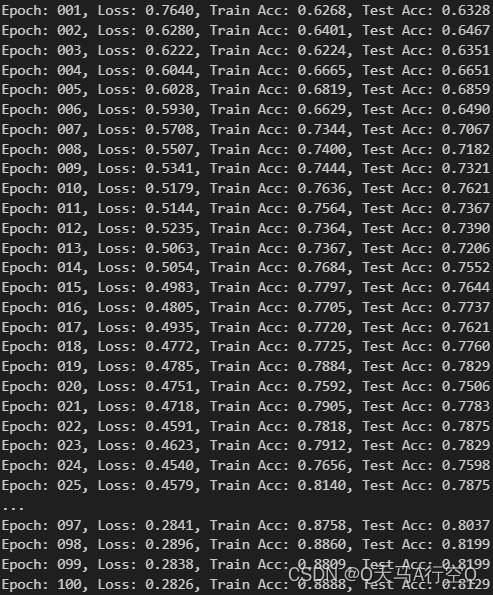
文献阅读
参考文献:Axiomatic Attribution for Deep Networks
文章目的:解释深层网络输入输出关联
文章概述:文章证明了两个新定理 S e n s i t i v i t y Sensitivity Sensitivity以及 I m p l e m e n t a t i o n I n v a r i a n c e Implementation\;Invariance ImplementationInvariance并且说明所有归因方法应该满足两个定理。之前大多方法均不满足所以作者提出一种新的归因方法—— I n t e g r a t e d G r a d i e n t s Integrated\;Gradients IntegratedGradients满足两个定理。
简单解释:
S e n s i t i v i t y Sensitivity Sensitivity:归因方法应该能够识别由于输入不同所带来的输出不通过。
I m p l e m e n t a t i o n I n v a r i a n c e Implementation\;Invariance ImplementationInvariance:等效网络应该满足对于所有输入模型输出相同。归因方法应该能够识别网络是否等效。
I n t e g r a t e d G r a d i e n t s IntegratedGradients IntegratedGradients: I n t e g r a t e d G r a n d s i ( x ) = ( x i − x i ′ ) ∫ α = 0 1 ∂ F ( x ′ + α × ( x − x ′ ) ) ∂ x i d α IntegratedGrands_i(x)=(x_i-x_i')\int_{\alpha=0}^{1}\frac{\partial F(x'+\alpha\times(x-x'))}{\partial x_i}d\alpha IntegratedGrandsi(x)=(xi−xi′)∫α=01∂xi∂F(x′+α×(x−x′))dα。这里 x ′ x' x′是基准输入。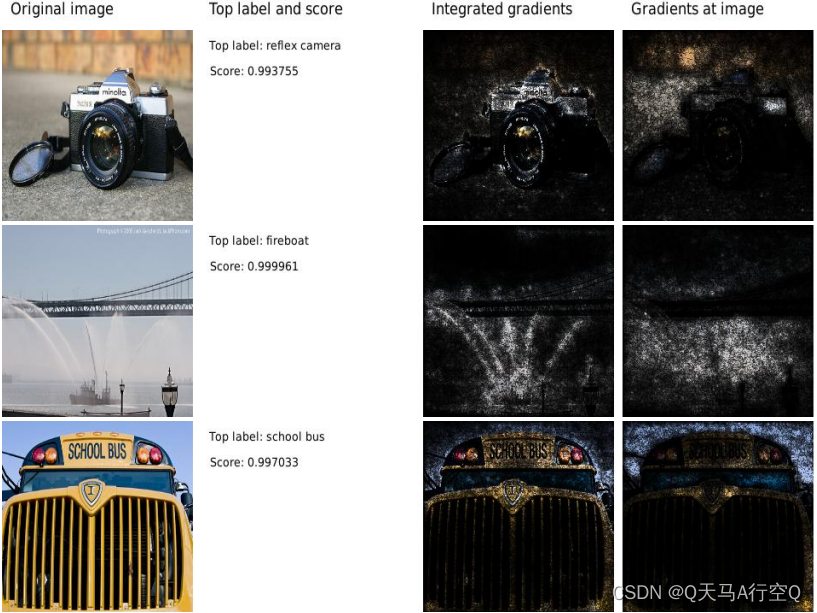
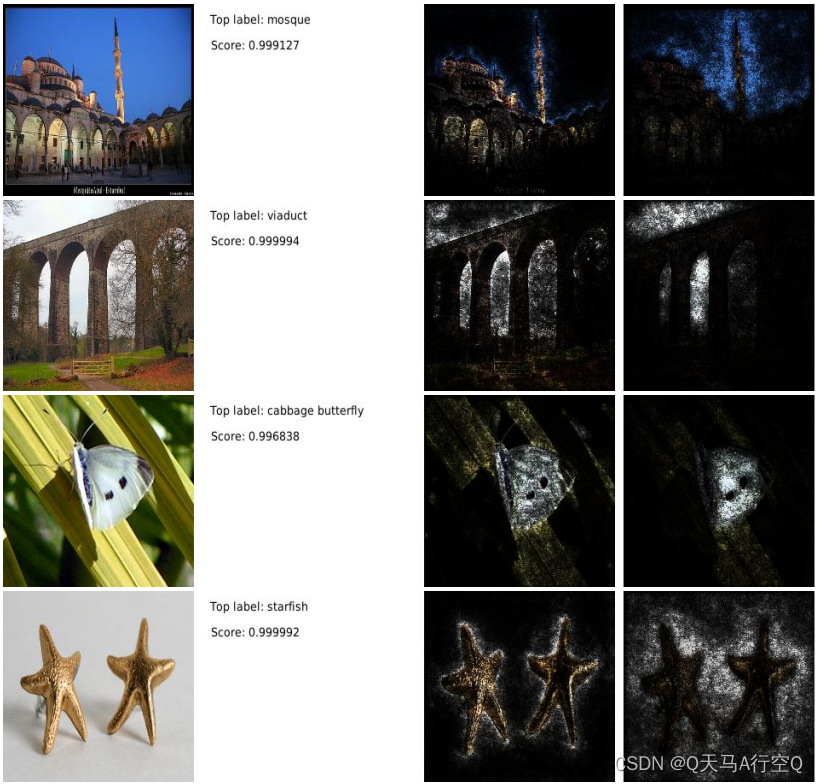
PS:从这个图我们可看出积分梯度方法的优越。文章还有许多其他好的工作。建议读者自行阅读。
重新回来
阅读文献之后我们重新回来。现在有了两种方法求解输出相对边权重的梯度1. A t t r i b u t i o n e i = ∣ ∂ F ( x ) ∂ ω e i ∣ Attribution_{e_i}=|\frac{\partial F(x)}{\partial \omega_{e_i}}| Attributionei=∣∂ωei∂F(x)∣ 2. A t t r i b u t i o n e i = ∫ α = 0 1 ∂ F ( x α ) ∂ ω e i d α Attribution_{e_i}=\int_{\alpha=0}^1\frac{\partial F(x_{\alpha})}{\partial \omega_{e_i}}d\alpha Attributionei=∫α=01∂ωei∂F(xα)dα。这里我们初始边缘权重为1基线为0简化公式否则就是十分复杂。
导库
from captum.attr import Saliency,IntegratedGradients
import numpy as np
定义函数
def model_forward(edge_mask,data):
    batch=torch.zeros(data.x.shape[0],dtype=int)
    out=model(data.x,data.edge_index,batch,edge_mask)
    return out

def explain(method,data,target=0):
    input_mask=torch.ones(data.edge_index.shape[1]).requires_grad_(True)
    if method=='ig':
        ig=IntegratedGradients(model_forward)
        mask=ig.attribute(input_mask,target=target,additional_forward_args=(data,),internal_batch_size=data.edge_index.shape[1])
    elif method=='saliency':
        saliency=Saliency(model_forward)
        mask=saliency.attribute(input_mask,target=target,additional_forward_args=(data,))
    else:
        raise Exception('Unknown explanation method')
    edge_mask=np.abs(mask.cpu().detach().numpy())
    if edge_mask.max()>0:
        edge_mask=edge_mask/edge_mask.max()
    return edge_mask
导库
from collections import defaultdict
import random
定义函数
def aggregate_edge_directions(edge_mask,data):
    edge_mask_dict=defaultdict(float)
    for val,u,v in list(zip(edge_mask,*data.edge_index)):
        u,v=u.item(),v.item()
        if u>v:
            u,v=v,u
        edge_mask_dict[(u,v)]+=val
    return edge_mask_dict
开始绘制
data=random.choice([t for t in test_dataset if not t.y.item()])
mol=to_molecule(data)
for title,method in [('Integrated Gradients','ig'),('Saliency','saliency')]:
    edge_mask=explain(method,data,target=0)
    edge_mask_dict=aggregate_edge_directions(edge_mask,data)
    plt.figure(figsize=(10,5))
    plt.title(title)
    draw_molecule(mol,edge_mask_dict)
jupyter notebook内的输出如下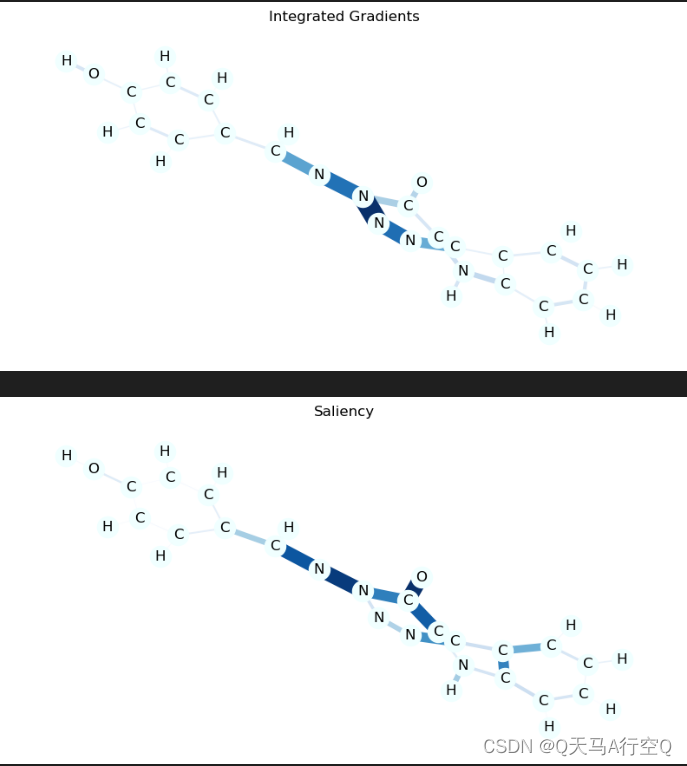
PS:越深说明对于目标影响越大。比如这里含氮容易导致突变。
更多推荐
 1
1 0
0- 0


 已为社区贡献1条内容

所有评论(0)