
cnn stride and padding_每日一学:如何计算cnn模型的计算量
整理自知乎问题:CNN 模型所需的计算力(flops)和参数(parameters)数量是怎么计算的?
链接:https://www.zhihu.com/question/65305385
首先是给出两个定义:
- FLOPS:全大写,是floating point operations per second的缩写,意指每秒浮点运算次数,理解为计算速度。是一个衡量硬件性能的指标。
- FLOPs:注意 s 小写,是floating point operations的缩写(s表复数),意指浮点运算数,理解为计算量。可以用来衡量算法/模型的复杂度。
这里说的自然是第二种 FLOPs,计算量,也就是模型的复杂度。
卷积层的 FLOPs
不考虑激活函数,对于单个输入特征图的计算公式为(没有考虑 batch ):
这里每个参数的含义: 是输入通道数量, K 表示卷积核的大小,H 和 W 是输出特征图(feature map)的大小, 是输出通道。
因为是乘法和加法,所以括号内是 2 ,表示两次运算操作。另外,不考虑 bias 的时候,有-1,而考虑 bias 的时候是没有 -1。
对于括号内的理解是这样的:
,第一项是乘法的运算数量,第二项是加法运算数量,因为 n 个数相加,是执行 n-1 次的加法次数,如果考虑 bias,就刚好是 n 次,也就是变成
对于整个公式来说就是分两步计算:
- 括号内是计算得到输出特征图的一个像素的数值;
- 括号外则是乘以整个输出特征图的大小,拓展到整个特征图。
举个例子,如下图所示是一个输出特征图的计算,其中输入特征图是 55 ,卷积核是 3 * 3,输出的特征图大小也是 3 * 3,所以这里对应公式中的参数,就是 K=3, H=W=3, 假设输入和输出通道数量都是 1,那么下图得到右边的特征图的一个像素的数值的计算量就是 (33)次乘法+(3 * 3-1)次加法 = 17,然后得到整个输出特征图的计算量就是 17 * 9 = 153.
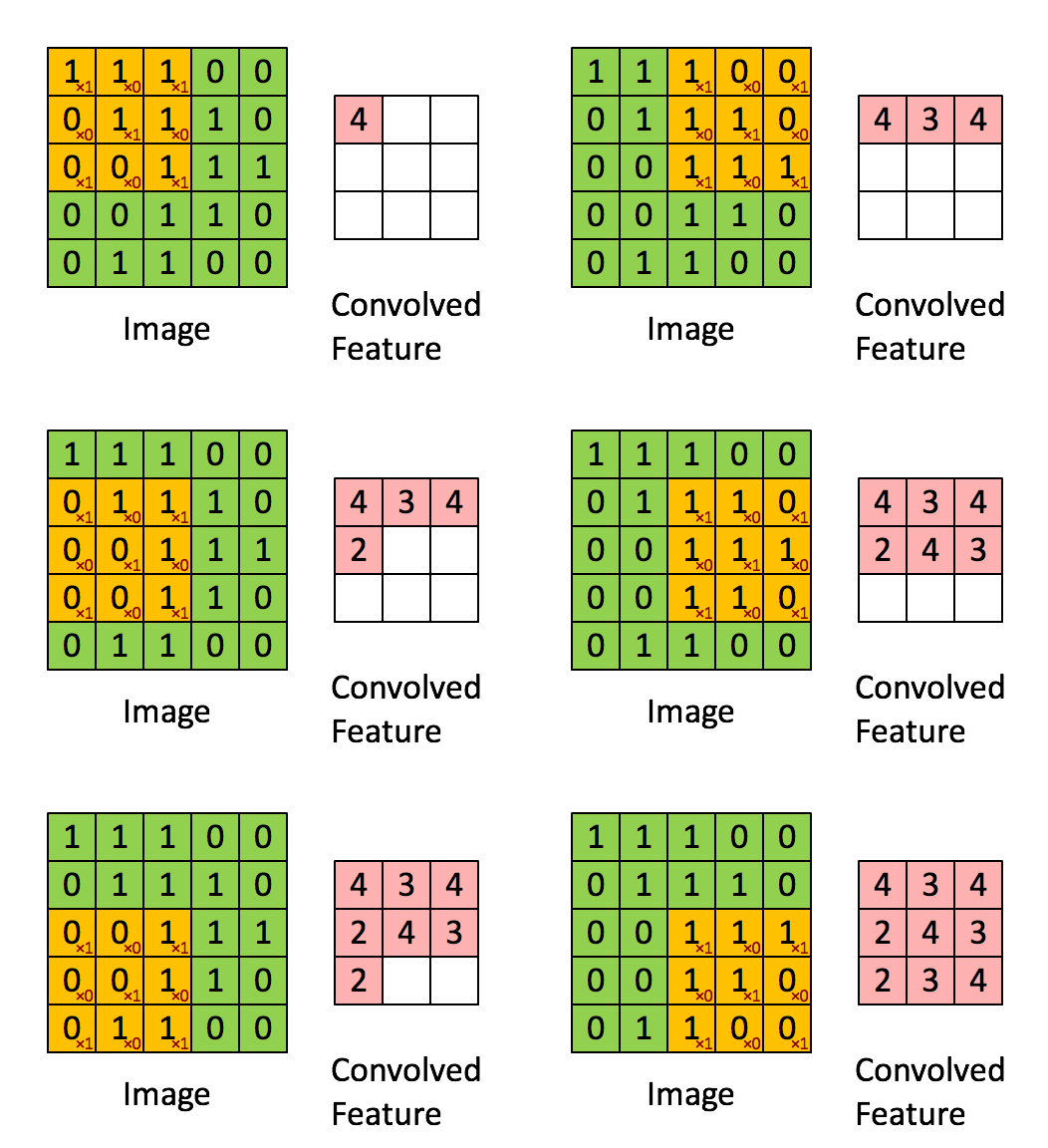
此处输入图片的描述
全连接层的 FLOPs
计算公式为:
(
每个参数的含义:I 是输入数量,O 是输出数量。
同样 2 也是表示乘法和加法,然后不考虑 bias 是 -1,考虑的时候没有 -1。
对于这个公式也是和卷积层的一样,括号内考虑一个输出神经元的计算量,然后扩展到所有的输出神经元。
相关实现代码库
GitHub 上有几个实现计算模型的 FLOPs 的库:
- https://github.com/Lyken17/pytorch-OpCounter
- https://github.com/sagartesla/flops-cnn
- https://github.com/sovrasov/flops-counter.pytorch
非常简单的代码实现例子,来自 https://github.com/sagartesla/flops-cnn/blob/master/flops_calculation.py
input_shape = (3 ,300 ,300) # Format:(channels, rows,cols)conv_filter = (64 ,3 ,3 ,3) # Format: (num_filters, channels, rows, cols)stride = 1padding = 1activation = 'relu'if conv_filter[1] == 0: n = conv_filter[2] * conv_filter[3] # vector_lengthelse: n = conv_filter[1] * conv_filter[2] * conv_filter[3] # vector_lengthflops_per_instance = n + ( n -1) # general defination for number of flops (n: multiplications and n-1: additions)num_instances_per_filter = (( input_shape[1] - conv_filter[2] + 2 * padding) / stride) + 1 # for rowsnum_instances_per_filter *= ((input_shape[1] - conv_filter[2] + 2 * padding) / stride) + 1 # multiplying with colsflops_per_filter = num_instances_per_filter * flops_per_instancetotal_flops_per_layer = flops_per_filter * conv_filter[0] # multiply with number of filtersif activation == 'relu': # Here one can add number of flops required # Relu takes 1 comparison and 1 multiplication # Assuming for Relu: number of flops equal to length of input vector total_flops_per_layer += conv_filter[0] * input_shape[1] * input_shape[2]if total_flops_per_layer / 1e9 > 1: # for Giga Flops print(total_flops_per_layer/ 1e9 ,'{}'.format('GFlops'))else: print(total_flops_per_layer / 1e6 ,'{}'.format('MFlops'))更多推荐



 0
0 0
0- 0


 已为社区贡献1条内容

所有评论(0)