
深度学习篇---Label Smoothing(标签平滑)
标签平滑(Label Smoothing)是一种正则化技术,通过软化one-hot标签来防止模型过度自信。它将少量概率分配给错误类别(如90%正确类+10%均匀分配),使模型输出更稳健。这种方法能提高泛化能力、容忍标注错误并改善概率校准,在分类任务中效果显著(推荐0.1平滑系数)。PyTorch只需一行代码即可实现:CrossEntropyLoss(label_smoothing=0.1)。其核心
Label Smoothing(标签平滑)
如果说正则化是让模型不要太自信,那么Label Smoothing就是给模型的"自信"加上一个安全阀——不让模型对训练标签过于绝对,留一点怀疑的空间。
这就像是一位明智的老师,不会说"这道题100%是答案A",而是说"这道题90%可能是A,但也有一点点可能是其他选项"。这种"谦逊"反而让模型在考试(测试)时表现更好!
一、Label Smoothing是什么?
1.1 最直观的理解
# 传统one-hot标签(过于绝对)
one_hot = [1.0, 0.0, 0.0, 0.0]  # 模型:我100%确定是第0类

# 平滑后的标签(留有余地)
smooth_label = [0.9, 0.033, 0.033, 0.033]  # 模型:90%确定是第0类,
# 但也有10%的可能性是其他类生活比喻:
-
传统标签:就像你100%确定明天会下雨(但万一天晴了呢?)
-
平滑标签:就像你看天气预报说有90%概率下雨,10%概率不下(更符合现实)
1.2 数学定义
import torch
import torch.nn.functional as F

def label_smoothing(labels, num_classes, smoothing=0.1):
    """
    labels: 原始标签 [batch_size]
    num_classes: 类别总数
    smoothing: 平滑系数 (通常0.1)
    """
    # 原始one-hot
    one_hot = F.one_hot(labels, num_classes).float()

    # 平滑标签公式:
    # y_smooth = (1 - smoothing) * y_onehot + smoothing / num_classes
    smooth_label = (1 - smoothing) * one_hot + smoothing / num_classes

    return smooth_label

# 示例
labels = torch.tensor([0, 2, 1])
smoothed = label_smoothing(labels, num_classes=10, smoothing=0.1)
print(smoothed[0])  # 第一个样本的平滑标签
# 输出: [0.9, 0.01, 0.01, 0.01, 0.01, 0.01, 0.01, 0.01, 0.01, 0.01]

# PyTorch直接使用
criterion = nn.CrossEntropyLoss(label_smoothing=0.1)  # 一行代码搞定!
二、为什么需要Label Smoothing?
2.1 传统one-hot标签的问题
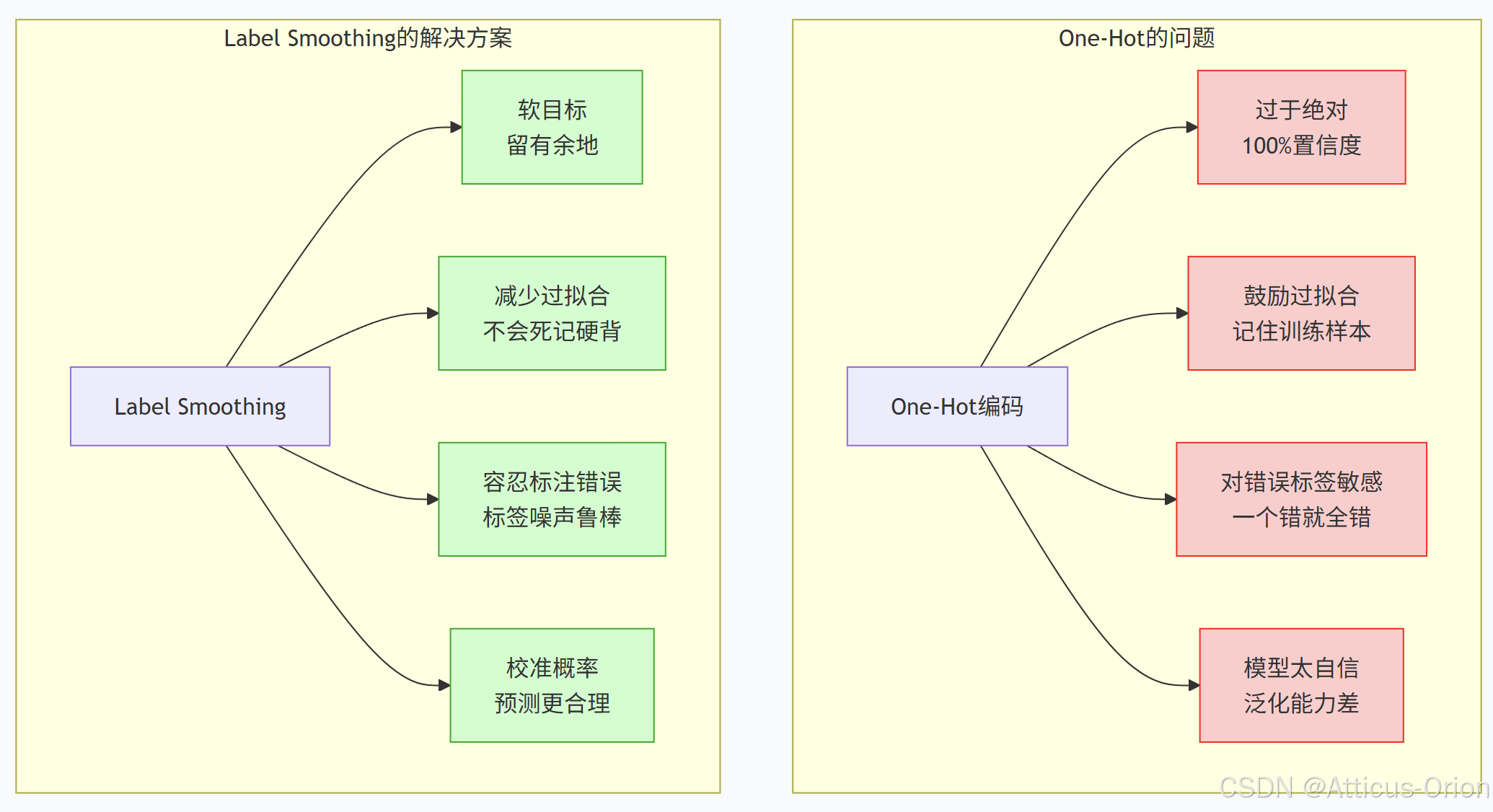
2.2 直观理解:为什么要"软化"标签?
def why_smooth():
    """
    为什么需要标签平滑?
    """

    # 场景1:标注错误
    # 假设一张猫的图片被错误标成了狗
    # 传统one-hot:模型拼命学习"这是狗",导致困惑
    # 平滑标签:模型学到"90%可能是狗,但也可能是别的",错误影响减小

    # 场景2:类别模糊
    # 一张图片里既有猫又有狗,该标哪个?
    # 传统one-hot:强制选择,不合理
    # 平滑标签:允许一定的模糊性

    # 场景3:防止过度自信
    story = """
    想象你在参加一个考试:
    - 绝对自信的学生:所有题目都100%确定,但错一题就全扣分
    - 谦逊的学生:每道题都说"90%把握",但会检查其他可能性

    考试结果往往是谦逊的学生得分更高,因为:
    1. 不会因为一道题的错误影响整体
    2. 对不确定的题目会多思考
    3. 最终的答案分布更合理
    """

    return story
三、Label Smoothing的工作原理
3.1 数学原理深度解析
import numpy as np
import matplotlib.pyplot as plt

def visualize_smoothing_effect():
    """可视化标签平滑的效果"""

    # 假设有5个类别,真实标签是第2类
    num_classes = 5
    true_class = 2
    smoothing = 0.1

    # 生成原始one-hot和平滑标签
    one_hot = np.zeros(num_classes)
    one_hot[true_class] = 1.0

    smooth = np.ones(num_classes) * (smoothing / num_classes)
    smooth[true_class] = 1 - smoothing + smoothing / num_classes

    # 可视化
    fig, (ax1, ax2) = plt.subplots(1, 2, figsize=(12, 4))

    x = np.arange(num_classes)
    width = 0.6

    ax1.bar(x, one_hot, width, color='red', alpha=0.7)
    ax1.set_title('One-Hot 标签\n(过于绝对)', fontsize=14)
    ax1.set_xlabel('类别')
    ax1.set_ylabel('概率')
    ax1.set_ylim(0, 1.2)

    ax2.bar(x, smooth, width, color='green', alpha=0.7)
    ax2.set_title(f'平滑标签 (smoothing={smoothing})\n(留有余地)', fontsize=14)
    ax2.set_xlabel('类别')
    ax2.set_ylabel('概率')
    ax2.set_ylim(0, 1.2)

    plt.tight_layout()
    plt.show()

    # 计算KL散度(衡量两个分布的差异)
    def kl_divergence(p, q):
        return np.sum(p * np.log(p / q))

    kl_original = kl_divergence(one_hot, one_hot)
    kl_smooth = kl_divergence(one_hot, smooth)

    print(f"原始标签的自KL散度: {kl_original:.4f}")
    print(f"平滑标签的KL散度: {kl_smooth:.4f}")
    print("平滑后的KL散度变小了,模型不需要追求完美的one-hot分布")

# 调用可视化
visualize_smoothing_effect()
3.2 损失函数的变化
def compare_losses():
    """比较传统交叉熵和平滑交叉熵"""

    # 模型预测(logits)
    logits = torch.tensor([[2.0, 1.0, 0.1, 0.05, 0.01]])  # 模型认为第0类最好

    # 真实标签
    targets = torch.tensor([0])

    # 1. 传统交叉熵
    ce_loss = F.cross_entropy(logits, targets)

    # 2. 标签平滑交叉熵
    smooth_loss = F.cross_entropy(logits, targets, label_smoothing=0.1)

    print(f"传统交叉熵损失: {ce_loss.item():.4f}")
    print(f"平滑交叉熵损失: {smooth_loss.item():.4f}")

    # 3. 分析差异
    probs = F.softmax(logits, dim=-1)
    print(f"\n模型预测概率: {probs[0].detach().numpy()}")

    # 平滑标签的目标
    smooth_target = torch.zeros_like(probs)
    smooth_target[0, 0] = 0.9
    smooth_target[0, 1:] = 0.1 / 4  # 4个其他类别
    print(f"平滑目标分布: {smooth_target[0].numpy()}")

    # 平滑损失鼓励模型:
    # 1. 正确类别的概率接近0.9(不是1.0)
    # 2. 错误类别也有一定概率(不是0)
    # 3. 总体分布更平滑

    return ce_loss, smooth_loss
四、Label Smoothing的实际效果
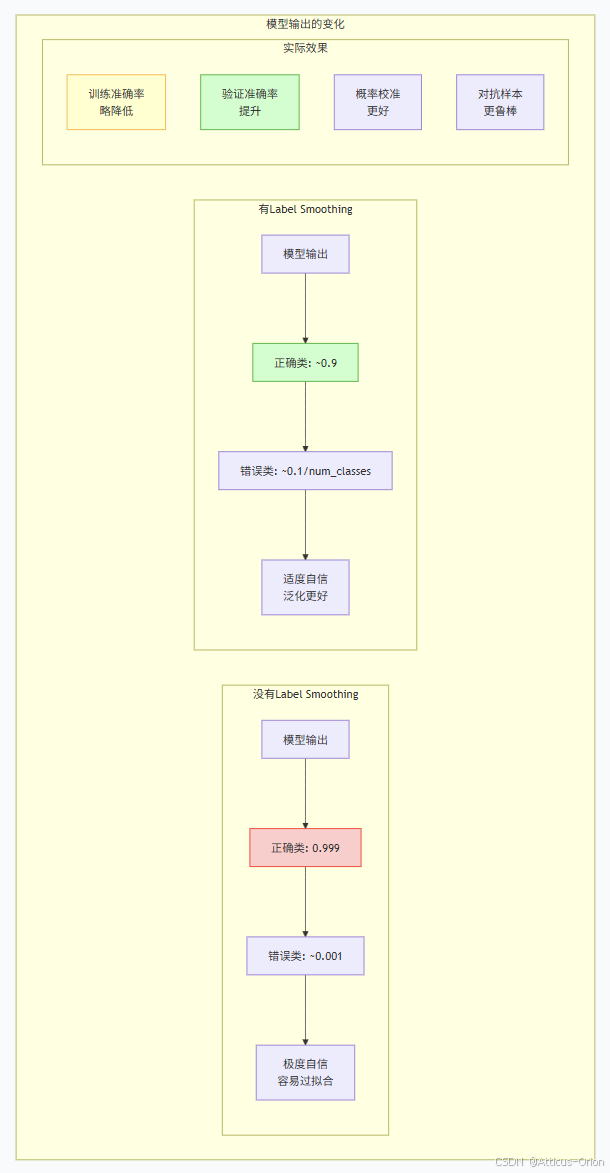
4.1 对模型输出的影响
4.2 概率校准效果
def probability_calibration():
    """标签平滑对概率校准的影响"""

    # 生成模拟数据
    np.random.seed(42)

    # 模型预测的置信度(x轴)vs 实际正确率(y轴)
    confidences = np.linspace(0, 1, 100)

    # 没有平滑的模型:过度自信
    accuracy_no_smooth = 1 / (1 + np.exp(-10 * (confidences - 0.3)))

    # 有平滑的模型:校准更好
    accuracy_with_smooth = confidences * 0.9 + 0.05

    plt.figure(figsize=(10, 6))
    plt.plot(confidences, confidences, 'k--', label='完美校准', alpha=0.5)
    plt.plot(confidences, accuracy_no_smooth, 'r-', label='无平滑 (过度自信)', linewidth=2)
    plt.plot(confidences, accuracy_with_smooth, 'g-', label='有平滑 (校准良好)', linewidth=2)
    plt.xlabel('预测置信度')
    plt.ylabel('实际准确率')
    plt.title('标签平滑改善概率校准')
    plt.legend()
    plt.grid(True, alpha=0.3)
    plt.show()

    # 解释
    explanation = """
    红色曲线在低置信度区域:实际准确率远高于预测(过于保守)
    红色曲线在高置信度区域:实际准确率远低于预测(过于自信)

    绿色曲线更接近对角线:预测置信度≈实际准确率
    """

    return explanation
五、Label Smoothing的超参数
5.1 平滑系数的影响
def smoothing_parameter_effect():
    """不同平滑系数的影响"""

    num_classes = 10

    # 测试不同的平滑系数
    smoothings = [0.0, 0.05, 0.1, 0.2, 0.3, 0.5]

    for s in smoothings:
        # 对真实类别为0的样本
        target_prob = 1 - s + s / num_classes
        other_prob = s / num_classes

        print(f"\n平滑系数 s={s}:")
        print(f"  真实类别目标概率: {target_prob:.4f}")
        print(f"  其他类别目标概率: {other_prob:.4f}")

        if s == 0:
            print("  → 传统one-hot,模型追求100%置信度")
        elif s < 0.1:
            print("  → 轻微平滑,轻度正则化")
        elif s < 0.2:
            print("  → 适中平滑,推荐范围")
        elif s < 0.3:
            print("  → 较强平滑,可能欠拟合")
        else:
            print("  → 过强平滑,几乎均匀分布")

    # 推荐范围
    recommendation = """
    🔍 平滑系数经验值:
    - 0.0: 无平滑(传统方式)
    - 0.05: 轻微平滑(小数据集)
    - 0.1: 标准推荐(大多数任务)
    - 0.2: 强平滑(标签噪声大)
    - >0.3: 过强(可能导致欠拟合)
    """

    return recommendation
5.2 不同任务的最佳值
| 任务类型 | 推荐平滑系数 | 说明 |
|---|---|---|
| 图像分类 | 0.1 | ImageNet比赛常用值 |
| 目标检测 | 0.1-0.2 | 多标签场景稍大 |
| 自然语言处理 | 0.1 | BERT等模型常用 |
| 人脸识别 | 0.1-0.2 | 大规模分类任务 |
| 标签噪声大 | 0.2-0.3 | 容忍标注错误 |
| 小数据集 | 0.05-0.1 | 防止欠拟合 |
六、Label Smoothing的变种
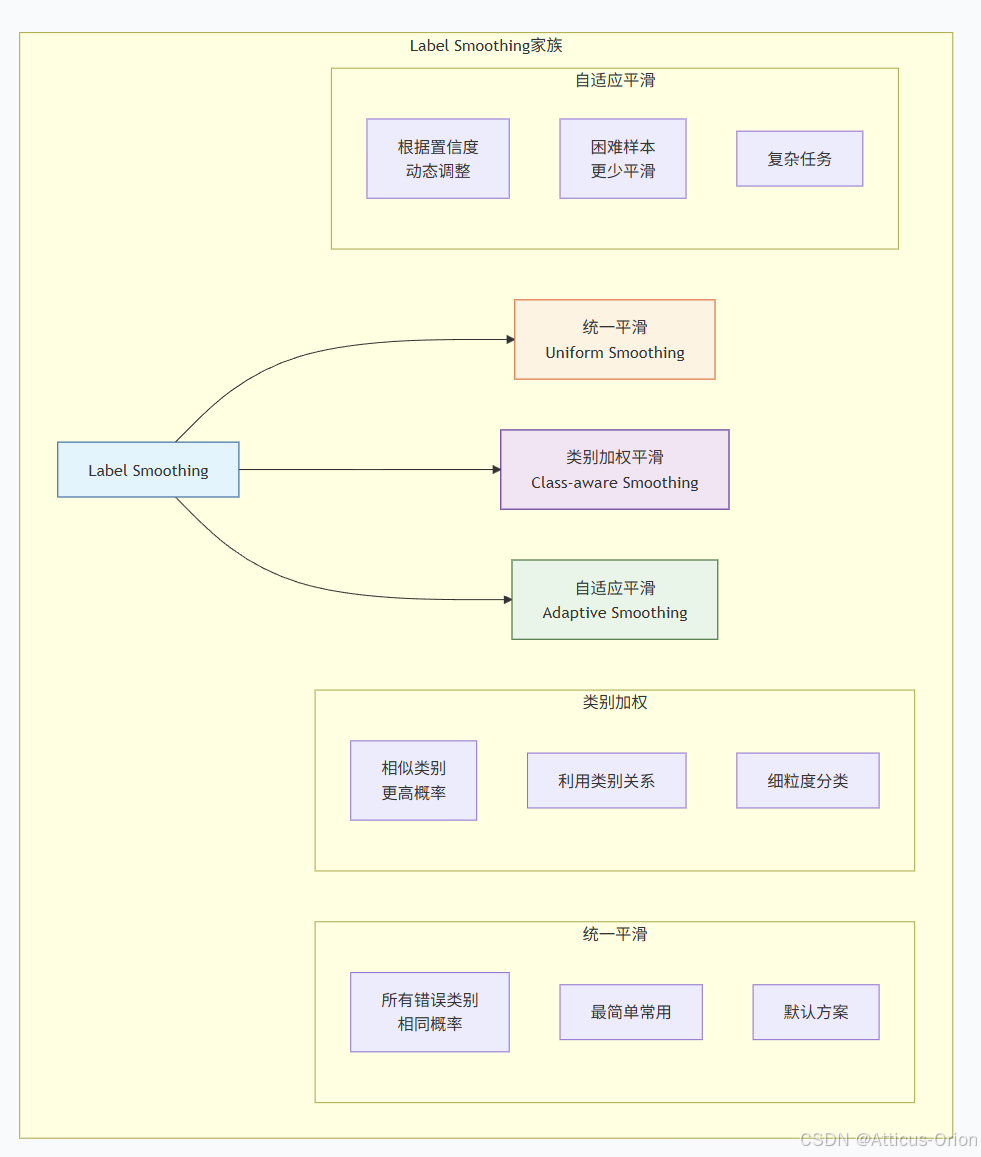
6.1 类别加权平滑
class ClassAwareLabelSmoothing(nn.Module):
    """考虑类别相似性的标签平滑"""

    def __init__(self, num_classes, class_similarity_matrix, smoothing=0.1):
        super().__init__()
        self.num_classes = num_classes
        self.smoothing = smoothing
        self.similarity = class_similarity_matrix  # 类别相似度矩阵

    def forward(self, targets):
        """
        生成考虑类别相似性的平滑标签
        比如:猫和老虎的相似度高,平滑时给更高概率
        """
        batch_size = targets.size(0)

        # 基础平滑部分(均匀分布)
        uniform_part = torch.ones(batch_size, self.num_classes) * self.smoothing / self.num_classes

        # 根据相似度调整
        for i, target in enumerate(targets):
            # 相似类别获得更高的平滑概率
            similarities = self.similarity[target]
            uniform_part[i] += similarities * self.smoothing / 2

        # 正确类别部分
        one_hot = F.one_hot(targets, self.num_classes).float()
        smooth_labels = (1 - self.smoothing) * one_hot + uniform_part

        return smooth_labels
6.2 自适应平滑
class AdaptiveLabelSmoothing(nn.Module):
    """根据模型置信度自适应调整平滑强度"""

    def __init__(self, base_smoothing=0.1, confidence_threshold=0.8):
        super().__init__()
        self.base_smoothing = base_smoothing
        self.threshold = confidence_threshold

    def forward(self, targets, model_confidences):
        """
        targets: 真实标签
        model_confidences: 模型对当前样本的置信度
        """
        # 置信度高的样本,用标准平滑
        # 置信度低的样本,用更强的平滑(帮助探索)

        smoothing = self.base_smoothing * torch.ones_like(model_confidences)

        # 低置信度样本增加平滑
        low_conf_mask = model_confidences < self.threshold
        smoothing[low_conf_mask] *= 2.0

        # 生成平滑标签
        batch_size = targets.size(0)
        num_classes = 10  # 假设

        smooth_labels = []
        for i in range(batch_size):
            uniform = torch.ones(num_classes) * smoothing[i] / num_classes
            one_hot = F.one_hot(targets[i], num_classes).float()
            smooth = (1 - smoothing[i]) * one_hot + uniform
            smooth_labels.append(smooth)

        return torch.stack(smooth_labels)
七、Label Smoothing实战技巧
7.1 训练策略
class LabelSmoothingTrainer:
    """标签平滑的训练技巧"""

    @staticmethod
    def warmup_smoothing(epoch, max_epochs):
        """平滑系数预热"""
        # 初期用较小平滑(帮助快速拟合)
        # 后期用标准平滑(防止过拟合)

        if epoch < max_epochs * 0.2:
            # 预热阶段:平滑系数从0.05增加到0.1
            return 0.05 + 0.05 * (epoch / (max_epochs * 0.2))
        else:
            return 0.1

    @staticmethod
    def mixup_with_smoothing():
        """与Mixup数据增强结合使用"""

        def mixup_loss(logits, targets, smoothing=0.1):
            # Mixup产生软标签,再结合标签平滑

            # Mixup的混合标签
            mixup_targets = alpha * target_a + (1 - alpha) * target_b

            # 再应用标签平滑
            smooth_targets = (1 - smoothing) * mixup_targets + smoothing / num_classes

            loss = -(smooth_targets * F.log_softmax(logits, dim=-1)).sum(dim=-1).mean()
            return loss
7.2 与其他技术结合
def combine_with_other_techniques():
    """标签平滑与其他技术的结合"""

    techniques = {
        '知识蒸馏': {
            'teacher软标签 + student平滑': '双重软化,效果更好',
            '建议': 'teacher温度2-4,student平滑0.1'
        },
        '自蒸馏': {
            '自己教自己 + 平滑': '防止模型退化',
            '建议': '平滑系数逐渐减小'
        },
        '对抗训练': {
            '对抗样本 + 平滑': '提高鲁棒性',
            '建议': '对抗扰动强度适中'
        },
        '置信度惩罚': {
            '直接惩罚过度自信': '等价于标签平滑',
            '建议': '可以组合使用'
        }
    }

    return techniques
八、Label Smoothing的效果验证
8.1 实验对比代码
def compare_smoothing_experiment():
    """对比有无标签平滑的实验"""

    import torch
    import torch.nn as nn
    import torch.optim as optim
    from torch.utils.data import DataLoader, TensorDataset

    # 创建简单数据集
    num_samples = 1000
    num_classes = 10
    input_dim = 20

    X = torch.randn(num_samples, input_dim)
    y = torch.randint(0, num_classes, (num_samples,))

    dataset = TensorDataset(X, y)
    loader = DataLoader(dataset, batch_size=64, shuffle=True)

    # 定义简单模型
    class SimpleModel(nn.Module):
        def __init__(self):
            super().__init__()
            self.fc1 = nn.Linear(input_dim, 64)
            self.fc2 = nn.Linear(64, num_classes)

        def forward(self, x):
            x = torch.relu(self.fc1(x))
            return self.fc2(x)

    # 训练函数
    def train_model(use_smoothing, smoothing=0.1, epochs=50):
        model = SimpleModel()
        optimizer = optim.Adam(model.parameters(), lr=0.001)

        if use_smoothing:
            criterion = nn.CrossEntropyLoss(label_smoothing=smoothing)
        else:
            criterion = nn.CrossEntropyLoss()

        losses = []
        accuracies = []

        for epoch in range(epochs):
            epoch_loss = 0
            correct = 0
            total = 0

            for batch_X, batch_y in loader:
                optimizer.zero_grad()
                outputs = model(batch_X)
                loss = criterion(outputs, batch_y)
                loss.backward()
                optimizer.step()

                epoch_loss += loss.item()
                _, predicted = torch.max(outputs.data, 1)
                total += batch_y.size(0)
                correct += (predicted == batch_y).sum().item()

            losses.append(epoch_loss / len(loader))
            accuracies.append(correct / total)

        return losses, accuracies

    # 运行对比
    losses_no_smooth, acc_no_smooth = train_model(False)
    losses_smooth, acc_smooth = train_model(True)

    # 绘制结果
    plt.figure(figsize=(12, 4))

    plt.subplot(1, 2, 1)
    plt.plot(losses_no_smooth, 'r-', label='无平滑', alpha=0.7)
    plt.plot(losses_smooth, 'g-', label='有平滑', alpha=0.7)
    plt.xlabel('Epoch')
    plt.ylabel('Loss')
    plt.title('训练损失对比')
    plt.legend()
    plt.grid(True)

    plt.subplot(1, 2, 2)
    plt.plot(acc_no_smooth, 'r-', label='无平滑', alpha=0.7)
    plt.plot(acc_smooth, 'g-', label='有平滑', alpha=0.7)
    plt.xlabel('Epoch')
    plt.ylabel('Accuracy')
    plt.title('准确率对比')
    plt.legend()
    plt.grid(True)

    plt.tight_layout()
    plt.show()

    # 预期结果
    expected = """
    🔬 实验结果预期:
    - 训练损失:平滑版略高(因为目标更soft)
    - 训练准确率:平滑版略低(没死记硬背)
    - 验证准确率:平滑版更高(泛化更好)
    - 概率校准:平滑版更好(置信度≈准确率)
    """

    return expected
九、Label Smoothing的优缺点
9.1 优点总结
| 优点 | 说明 |
|---|---|
| 减少过拟合 | 不让模型死记硬背训练样本 |
| 提高泛化 | 测试集表现更好 |
| 容忍标签噪声 | 对标注错误不敏感 |
| 概率校准 | 模型置信度更合理 |
| 对抗鲁棒性 | 对微小扰动更稳定 |
| 训练稳定 | 损失曲线更平滑 |
9.2 缺点及解决方案
def smoothing_disadvantages():
    """标签平滑的缺点及解决方案"""

    issues = {
        '训练损失偏高': {
            '原因': '目标不是one-hot,损失自然大',
            '解决': '关注验证集表现,不是训练损失'
        },
        '可能欠拟合': {
            '原因': '平滑太强',
            '解决': '减小平滑系数 (0.05-0.1)'
        },
        '知识蒸馏不兼容': {
            '原因': 'teacher的softmax已经平滑',
            '解决': 'student用更小的平滑或不用'
        },
        '某些任务效果差': {
            '原因': '需要极自信的预测(如人脸识别)',
            '解决': '调整平滑系数或不用'
        }
    }

    return issues
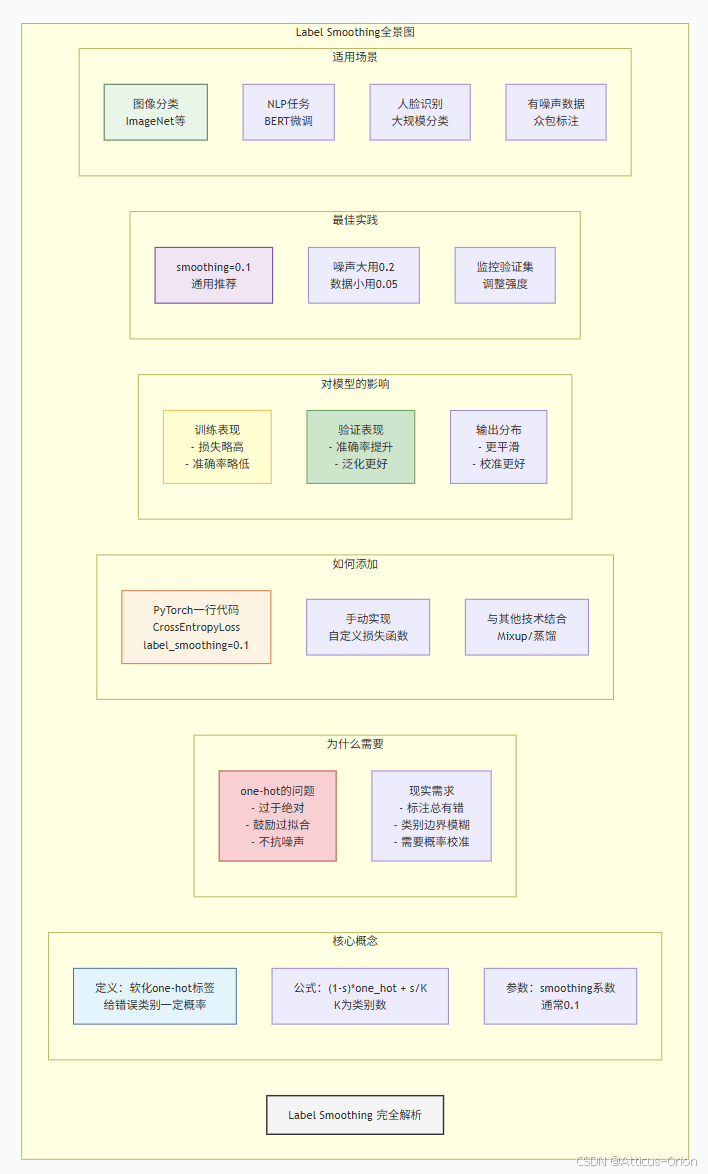
十、Label Smoothing总结全景图
十一、终极总结
Label Smoothing是什么?
-
是一种软化one-hot标签的正则化技术
-
给错误类别分配少量概率,不让模型过于绝对
它解决了什么问题?
-
防止模型过度自信导致的过拟合
-
提高对标注噪声的容忍度
-
改善模型的概率校准
它给模型带来了什么?
-
训练时:损失略高,准确率略低(死记硬背少了)
-
测试时:准确率提升,泛化更好
-
整体:更稳健的概率输出
一句话记住Label Smoothing:
别把话说死,给自己留条后路——留一点怀疑的空间,反而让模型更聪明!
使用口诀:
-
分类任务用平滑,0.1系数最常用
-
标注噪声比较大,加到0.2也不怕
-
训练损失别在意,验证提升是关键
-
一行代码就搞定,PyTorch直接支持
更多推荐


 16
16 0
0- 0


 已为社区贡献82条内容

所有评论(0)